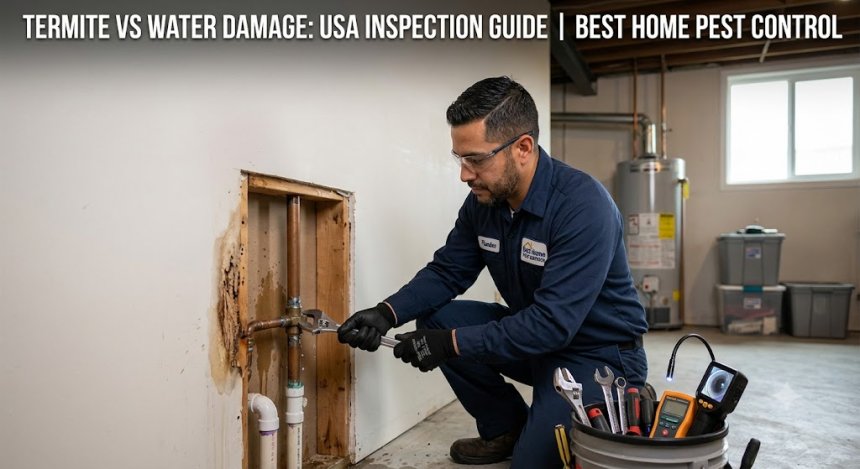
Termite vs Water Damage: USA Inspection Guide | Best Home Pest Control
Can’t tell if wood damage is from termites or water leaks? Learn visual, structural, and tactile diagnostic tests to act fast. Call 937-809-8658 today.

Termite Damage vs. Water Damage: How to Recognize the Difference
Moisture and wood destruction operate as a destructive symbiotic team across American residential architecture. Whether dealing with high ambient humidity in southern humid subtropical zones, spring thaw cycles across the Midwest and Northeast, or seasonal rainfall in coastal regions, moisture accumulation is almost always the prerequisite trigger for wood-destroying organism (WDO) infestations.
Modern and historical American home construction—ranging from post-and-beam crawlspaces and slab-on-grade foundations to wood-framed structures over full basements—presents distinct structural vulnerabilities:
+-----------------------------------------------------------------------------------+
|                            STRUCTURAL VULNERABILITY PATHWAYS                       |
+-----------------------------------------------------------------------------------+
|  [ Roof/Gutters ] ---> Water Ingress ---> Wood Rot / Softening                    |
|                                                  |                                |
|                                                  v                                |
|  [ Soil Line ]    ---> Subterranean Termites Attracted to Damp Framing            |
|                                                  |                                |
|                                                  v                                |
|  [ Foundation ]   ---> Hydrostatic Pressure + Cracks = Ideal Micro-Climate         |
+-----------------------------------------------------------------------------------+
-
Slab-on-Grade Foundations: Plumbing penetrations through concrete slabs create hidden pathways where subterranean termites (Reticulitermes spp.) enter. Small plumbing weeping under the slab saturates adjacent sill plates, attracting worker termites directly through microscopic concrete cold joints.
-
Crawlspaces & Basements: Poorly ventilated crawlspaces without 6-mil polyethylene vapor barriers frequently maintain relative humidity levels above 70%. Subterranean termites require wood moisture content above 15–20% to feed efficiently without desiccating. Water vapor driven up through soil softens subflooring and rim joists, creating optimal entry zones.
-
Stucco and Exterior Insulation and Finish Systems (EIFS): Stucco below the soil grade traps moisture against wood framing. Termites build mud tubes behind the stucco shell, leaving structural damage completely hidden from standard visual inspections until framing fails.
Understanding whether structural softening, blistering paint, or wood decay stems from an active plumbing/roof leak or a subterranean termite colony is essential for preventing thousands of dollars in uninsurable structural repairs.
3. Seasonal Pest Prevention Framework
Managing moisture and preventing subterranean termite colonization requires a year-round structural maintenance protocol.
+-----------------------------------------------------------------------------------+
|                        SEASONAL MOISTURE & PEST MANAGEMENT                        |
+-----------------------------------------------------------------------------------+
|  SPRING/SUMMER           |  FALL/WINTER             |  YEAR-ROUND INTERIOR        |
|  - 18-24" Veg Buffer     |  - Seal Envelope         |  - Crawlspace RH <50%       |
|  - Extend Downspouts 5'+ |  - Manage Firewood       |  - Fix Micro-Leaks          |
|  - Maintain Soil Gap 6"+ |  - Clear Weep Holes      |  - Monitor Plumbing Chases  |
+-----------------------------------------------------------------------------------+
Fall/Winter Protocols
-
Exterior Building Envelope Maintenance: Inspect and replace failing silicone or polyurethane sealants around exterior penetrations (hose bibbs, gas lines, electrical conduit) where moisture can enter wall cavities.
-
Firewood & Cellulose Storage: Elevate stored firewood at least 6 inches off the ground and maintain a minimum 20-foot distance from structural foundations. Never store scrap lumber, cardboard boxes, or wooden pallets in crawlspaces or against exterior walls.
-
Weep Hole Protection: Ensure exterior brick veneer weep holes remain clear of soil, mulch, and leaf litter. Insert stainless steel wire mesh weep hole covers to maintain air ventilation while blocking pest entry.
Spring/Summer Protocols
-
Vegetation Clearances: Establish an 18-to-24-inch cleared vegetation buffer around the foundation perimeter. Prune tree branches, foundation shrubs, and climbing vines away from siding and rooflines to allow sunlight to dry out soil edges.
-
Drainage & Grade Management: Grade topsoil away from the foundation at a slope of at least 6 inches over the first 10 feet. Extend gutter downspout splash blocks or drain lines a minimum of 5 feet away from foundation walls to prevent soil saturation.
-
Siding-to-Soil Clearance: Maintain a minimum 6-inch bare concrete gap between the bottom edge of wood, vinyl, or stucco siding and the top of the soil or mulch bed.
Year-Round Interior Habits
-
Relative Humidity Control: Maintain subfloor and crawlspace relative humidity strictly below 50% using heavy-duty, temperature-controlled dehumidifiers and vapor barriers to prevent wood decay fungi and termite attraction.
-
Plumbing Maintenance: Fix slow plumbing leaks beneath sinks, behind washing machines, and around water heaters immediately.
-
Chemical Application Awareness: Never apply off-the-shelf pyrethroid aerosol sprays directly onto active termite mud tubes or damaged wood; doing so causes the colony to split (repellent scatter effect) and re-route through uninspected structural voids.
4. Emergency Dispatch Matrix
| Emergency Scenario | Primary Structural & Health Risks | Immediate Action Required |
| Indoor Termite Alate Swarm (Hundreds of winged insects emerging from baseboards or light fixtures) | Active, mature termite colony residing directly inside the home's structural framing; imminent risk of load-bearing wood failure. | Do not spray aerosol bug spray. Vacuum up swarming insects, save several specimens in a sealed glass jar for species identification, and call Best Home Pest Control at 937-809-8658 immediately. |
| Buckling Subfloor or Sagging Floor Joists | Advanced fungal rot combined with subterranean termite destruction; high structural collapse risk under heavy loads. | Vacate the immediate area above structural floor sagging. Avoid placing heavy furniture over the affected area. Schedule an immediate structural WDO inspection. |
| Rodent Activity in Living/Food Prep Zones | Chewed electrical insulation (fire hazard), contamination via Salmonella, Leptospirosis, and Hantavirus; airborne pathogens from droppings. | Isolate food sources in glass/metal containers. Do not dry sweep droppings (prevents aerosolizing pathogens). Call for immediate exclusion and sanitation protocols. |
| Stinging Insect Nest Inside Wall Void | Structural drywall erosion from nest moisture; high risk of mass indoor stinging events and severe anaphylactic reactions. | Seal the interior room door. Do not plug the exterior exit hole (forces yellowjackets/wasps to chew through interior drywall into living space). Call for targeted vacuuming and non-repellent dust extraction. |
5. Systematic 5-Step Professional Inspection Workflow
When Best Home Pest Control technicians evaluate a home for wood destruction, we use a structured 5-step diagnostic process grounded in Integrated Pest Management (IPM):
+-----------------------------------------------------------------------------------+
|                        5-STEP DIAGNOSTIC WORKFLOW MATRIX                          |
+-----------------------------------------------------------------------------------+
|  [Step 1] Exterior Perimeter & Entry Point Mapping                                |
|     └─ Soil-to-structure contact, downspout discharge, mulch depth, mud tubes      |
|                                                                                   |
|  [Step 2] Interior Micro-Habitat & Moisture Analysis                              |
|     └─ Thermal imaging (FLIR), pinless moisture meters, digital borescopes        |
|                                                                                   |
|  [Step 3] Species Identification & Damage Staging                                 |
|     └─ Distinguish Reticulitermes vs. Coptotermes; quantify gallery depth          |
|                                                                                   |
|  [Step 4] Custom IPM Formulation                                                  |
|     └─ Combine liquid non-repellents (fipronil) with chitin synthesis inhibitors |
|                                                                                   |
|  [Step 5] Targeted Application, Exclusion, & Long-Term Monitoring                 |
|     └─ Precision soil injection, sub-slab drilling, annual station monitoring    |
+-----------------------------------------------------------------------------------+
Step 1: Exterior Perimeter & Entry Point Mapping
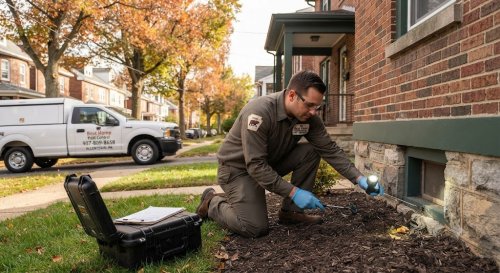
We begin with a comprehensive 360-degree assessment of the building envelope:
-
Checking soil-to-structure contacts, grade levels, and downspout discharge zones.
-
Inspecting foundation expansion joints, slab cracks, stucco termination lines, and brick weep holes for active mud tubes (exploratory shelter tubes).
Step 2: Interior Micro-Habitat & Moisture Analysis
Technicians move inside to evaluate load-bearing elements, focusing on crawlspaces, basements, utility chases, and wet walls (bathrooms/kitchens):
-
Using pinless moisture meters to detect hidden moisture pockets behind drywall and under subfloors.
-
Deploying FLIR thermal imaging cameras to identify temperature anomalies caused by active termite nests or hidden water leaks.
Step 3: Species Identification & Population Density Staging
If damage or live insects are detected, we confirm species identity:
-
Distinguishing Eastern Subterranean Termites (Reticulitermes flavipes) from Formosan Subterranean Termites (Coptotermes formosanus) or Drywood species (Incisitermes spp.).
-
Evaluating damage depth using acoustic sounding tools and digital borescopes to check whether timber destruction is localized or structural.
Step 4: Custom Integrated Pest Management (IPM) Formulation
We build a targeted strategy based on verified findings:
-
Addressing structural vulnerabilities and source moisture before applying chemical controls.
-
Selecting appropriate non-repellent liquid termiticides (e.g., fipronil) or chitin synthesis inhibitor baiting systems based on soil chemistry, foundation type, and water table depth.
Step 5: Targeted Application, Exclusion Installation & Follow-Up Monitoring
-
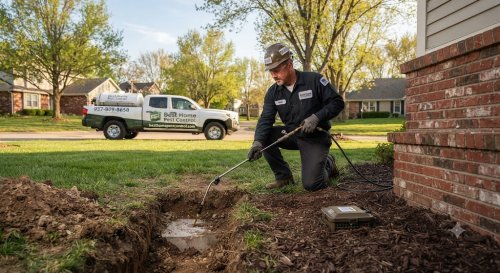
Executing precision soil injection, trenching along foundation walls, or sub-slab drilling along interior garage/porch joints.
-
Installing structural exclusions (copper mesh, polyurethane sealants) to close pest entry gaps.
-
Establishing ongoing monitoring stations to confirm total colony elimination.
6. DIY Boundaries vs. Professional Interventions
| Safe DIY Homeowner Tasks | High-Risk / Pro-Only Interventions |
| Cleaning gutters and extending downspout drain lines 5+ feet from foundation. | Direct soil trenching and applying liquid termiticides near groundwater/wells. |
| Fixing surface plumbing leaks (replacing sink trap gaskets, faucet washers). | Injecting non-repellent chemistries into concrete slab plumbing penetrations. |
| Clearing leaf litter, mulch, and vegetation away from foundation wall edge. | Structural framing replacement or installation of temporary support jacks. |
| Installing interior dehumidifiers to maintain basement relative humidity <50%. | Sub-slab drilling and high-pressure chemical injections beneath living spaces. |
| Replacing rotted, non-structural exterior deck fascia boards or trim. | Comprehensive termite colony elimination using chitin synthesis inhibitor baits. |
+-----------------------------------------------------------------------------------+
|                        4 MANDATORY PROFESSIONAL TRIGGER CONDITIONS                |
+-----------------------------------------------------------------------------------+
|  [Trigger 1] Sightings of Swarmers / Wings Inside Living Areas                    |
|  [Trigger 2] Auditory Head-Banging / Wall Rustling Acoustics                      |
|  [Trigger 3] Structural Mud Tubes / Frass / Honeycombed Wood                      |
|  [Trigger 4] Sudden Flooring Sag / Door Frame Misalignment                        |
+-----------------------------------------------------------------------------------+
7. Warning Signs: Sensory Diagnostics & Risks of Delay
Distinguishing between water damage and termite damage requires analyzing visual, auditory, and olfactory indicators:
+-----------------------------------------------------------------------------------+
|                           SENSORY DIAGNOSTIC MATRIX                               |
+-----------------------------------------------------------------------------------+
|  SENSE     | WATER DAMAGE                       | TERMITE DAMAGE                  |
|  ----------+------------------------------------+---------------------------------|
|  Visual    | Water rings, dark discoloration,   | Mud tubes, blistered paint,     |
|            | wood swells across spring/summer   | honeycombed wood along grain,   |
|            | growth rings evenly; dark rot fungi| soft frass, discarded wings.    |
|  ----------+------------------------------------+---------------------------------|
|  Auditory  | Solid, dull thud when tapped;      | Hollow sound; active rustling / |
|            | no internal acoustics.             | soldier head-banging ticks.     |
|  ----------+------------------------------------+---------------------------------|
|  Olfactory | Heavy, damp, earthy mold/musty     | Pungent, mildewy odor mixed     |
|            | decay odor.                        | with damp soil/fungal scent.    |
+-----------------------------------------------------------------------------------+
Visual Differences
-
Water Damage: Wood swells, softens, and discolors evenly across both earlywood and latewood growth rings. Paint over water-damaged wood blisters into large, soft, fluid-filled bubbles. Structural rot fungi (Poria or Coniophora species) often turn the wood brown and cause it to crack across the grain into cubical shapes (cubical brown rot).
-
Termite Damage: Subterranean termites eat along the soft spring grain of the wood, leaving the harder summer grain intact. This creates a distinct honeycombed internal structure packed with soil, fecal spots, and mud galleries. Paint over termite-damaged wood develops tiny pinholes or looks like fine, rippled "wavelike" channels (resembling thin wood veneer over emptiness).
  WATER DAMAGE (Cubical Rot)           TERMITE DAMAGE (Honeycombed)
  +-----------------------+            +-----------------------+
  |  [===]  [===]  [===]  |            |  ===================  |  <- Hard Grain Intact
  |  [===]  [===]  [===]  |  Cracks    |  -------------------  |  <- Soft Grain Eaten
  |  [===]  [===]  [===]  |  Across    |  ===================  |     (Packed with Mud)
  +-----------------------+  Grain     +-----------------------+
Auditory Diagnostics
-
Water Damage: Tapping water-damaged wood with a screwdriver handle yields a solid, dull thud due to moisture density.
-
Termite Damage: Tapping termite-damaged wood produces a hollow, papery sound. When disturbed, soldier termites bang their heads rhythmically against gallery walls as an alarm, producing a distinct, dry clicking or rustling sound inside wall voids.
Olfactory Diagnostics
-
Water Damage: Produces a heavy, damp, earthy, or musty odor associated with active mold and mildew spores (Cladosporium, Penicillium).
-
Termite Damage: Produces a pungent odor combining damp soil with fungal decay smells generated by fecal material line galleries within structural voids.
Risks of Delay
Delaying treatment when wood damage is discovered can lead to cascading structural issues:
-
Load-Bearing Deflection: Termites can hollow out floor joists, sill plates, and wall studs, leading to sagging subfloors and unaligned door frames.
-
Electrical Fire Hazards: Subterranean termites frequently chew through electrical cable sheathing inside wall voids while searching for cellulose, exposing bare live wires that can short-circuit and ignite nearby dry wood frass.
-
Insurance Exclusion: Standard home insurance policies exclude termite, insect, and rodent damage as "preventable home maintenance issues," leaving homeowners responsible for total structural repair costs.
8. Cost Breakdown & Pricing Variables
Evaluating and resolving wood destruction involves several structural and chemical application cost factors:
+-----------------------------------------------------------------------------------+
|                        COST & PRICING VARIABLE PROFILE                            |
+-----------------------------------------------------------------------------------+
|  Diagnostic & Inspection Fees  | $150 – $350 (Often credited toward treatment)    |
|  Perimeter Trenching/Injection | $8 – $18 per linear foot                         |
|  Sub-Slab Concrete Drilling    | $12 – $25 per linear foot                        |
|  Bait Station Installation     | $1,200 – $2,800 (Includes initial monitoring)    |
|  Structural Repair / Exclusion | Variable (Based on carpentered scope of work)    |
+-----------------------------------------------------------------------------------+
Key Drivers of Local Pricing:
-
Linear Footage & Accessibility: Liquid perimeter treatments are priced per linear foot. Obstructions like concrete patios, attached garages, and finished basements require high-pressure sub-slab drilling, which increases labor costs.
-
Treatment Methodology: Continuous liquid barrier treatments using non-repellent transfer chemistry (e.g., fipronil) carry higher upfront material costs but offer long-term residual protection. Chitin synthesis inhibitor baiting systems carry lower initial labor costs but require paid annual monitoring contracts.
-
Structural Damage Repairs: Sistering compromised joists, replacing rotted sill plates, and installing temporary structural support jacks require specialized carpentry work beyond standard pest control treatments.
-
Maintenance Contracts: One-time spot treatments do not carry structural repair guarantees. Ongoing annual renewal programs (typically $250–$450/year) include annual re-inspections and full repair coverage warranties against future infestations.
9. Professional Equipment & Diagnostic Arsenal
| Diagnostic Tool / Technology | Technical Mechanism | Practical Application in Damage Differentiation |
| FLIR Thermal Imaging Camera | Detects minute surface temperature differentials ($\Delta T \ge 0.5^\circ\text{C}$) caused by evaporative cooling or metabolic thermal heat. | Differentiates cool, damp active plumbing leaks from warm, dense termite nest clusters (calderas) behind sealed drywall without invasive destruction. |
| Pinless & Pin-Type Moisture Meters | Measures electrical resistance/capacitance to determine percentage Wood Moisture Content (%WMC). | Identifies if wood is susceptible to rot fungi (>20% WMC) or active termite foraging (>15% WMC), highlighting hidden moisture sources. |
| Digital High-Definition Borescope | Uses a flexible 5.5mm fiber-optic lens with integrated LED illumination passed through minimal pilot holes. | Allows direct visual inspection of internal wall voids, floor joist cavities, and honeycomb gallery patterns without removing drywall panels. |
| Acoustic Emission Detector | Utilizes ultra-sensitive piezoelectric sensors to amplify high-frequency elastic stress waves (20 kHz–100 kHz). | Picks up minute structural vibrations produced by soldier termites head-banging and worker termites tearing wood fibers inside timber. |
| Non-Repellent Transfer Chemistries | Uses active ingredients like fipronil or chlorfenapyr that insects cannot detect via olfaction or gustation. | Allows worker termites to pass through treated soil, pick up lethal doses, and transfer the active ingredient throughout the colony via social grooming (trophallaxis). |
10. Industry Hard Truths & Insider Facts
-
OTC Total-Release Bug Bombs / Foggers Make Termite Damage Worse: Consumer aerosol foggers release a fine pyrethroid mist that deposits onto exposed surface areas without penetrating inner wood framing. Pyrethroids are strong insect repellents. When a homeowner sets off a bug bomb for swarming termites, it triggers a repellent scatter effect—scaring the active colony away from that single wall void and forcing them deeper into structural framing, subfloors, and ceiling joists.
-
Ultrasonic Repellers are Scientifically Ineffective: Decades of peer-reviewed entomological research confirm that ultrasonic pest plug-in devices do not deter subterranean termites or wood-destroying beetles. Termites navigate via tactile, chemical (pheromone), and moisture gradients, ignoring high-frequency sound waves.
-
Chemical Applications Without Physical Moisture / Exclusion Corrections Fail: Liquid termiticide applications in soil will eventually degrade if a broken gutter or plumbing leak continuously saturates the treatment zone. Water flow leaches non-repellent chemistries away from foundation edges, opening untreated entry paths into the home.
-
The Insurance Reality Trap: Over 95% of standard homeowners insurance policies in the United States explicitly exclude damage caused by termites, carpenter ants, and wood-boring beetles. Insurers define wood-destroying insect damage as "preventable home maintenance," placing all repair costs directly on the homeowner.
11. Comprehensive FAQ Section
How long does it take to eliminate a subterranean termite colony after treatment?
Using modern non-repellent liquid transfer chemistries (fipronil) or chitin synthesis inhibitor baiting systems, total colony elimination typically occurs within 60 to 90 days. Non-repellent chemistry relies on worker termites transferring active ingredients back to the queen and brood through social grooming (trophallaxis).
Are professional termite treatments safe for my children and pets?
Yes, when applied by a licensed technician in accordance with EPA label instructions. Liquid termiticides are injected deep into soil perimeters or beneath concrete slabs, completely isolating chemical residues from living areas. Synthetic chitin synthesis baits are enclosed inside locked, tamper-resistant ground stations accessible only by specialized keys.
How can I visually tell the difference between a winged termite swarmer and a swarming carpenter ant?
Look at three anatomical features:
-
Waist: Termites have a broad, uniform waist with no thin pinch. Ants have a narrow, pinched waist (petiole).
-
Antennae: Termite antennae are straight and resemble small strings of beads. Ant antennae are distinctly elbowed.
-
Wings: Termite swarmers have four wings of equal length and shape that are twice as long as their body. Carpenter ants have front wings that are noticeably larger than their hind wings.
  TERMITE SWARMER                      CARPENTER ANT SWARMER
     \  ||  /  <- Straight Antennae       \  /  <- Elbowed Antennae
      \ || /                               \/
      (____)   <- Broad Waist            (  )   <- Pinched Waist
      (____)                             (  )
     / |  | \                            / || \
    /  |  |  \                          /  ||  \
   Equal Length Wings                 Unequal Wing Lengths
How should I prepare my home for a professional termite inspection?
Provide clear access along foundation walls by moving stored items, cardboard boxes, and stored furniture at least 2 feet away from interior garage walls, basement perimeters, and crawlspace hatches. Clear thick brush, firewood, or debris leaning against exterior foundation walls.
Why am I seeing a sudden increase in insect activity ("flushing out") after a treatment?
Non-repellent transfer chemistries do not kill termites instantly. As the active ingredient disrupts the insects' central nervous system or molting processes, worker termites lose their directional orientation, abandon their galleries, and stumble toward surface light sources. This temporary "flushing out" effect is a normal sign that the chemical is moving through the colony population.
Can expanding spray foam stop rodents and subterranean termites?
No. Standard off-the-shelf polyurethane expanding foam expands into soft, closed-cell foam that rodents easily gnaw through and termites chew through to construct protected galleries. Effective structural exclusion requires packing openings with stainless steel mesh, copper mesh, or heavy-gauge hardware cloth before sealing with high-grade polyurethane sealant.
How often should homes undergo a professional wood-destroying insect inspection?
Professional inspections should occur annually. Homes located in high-moisture regions, those with historical subterranean termite activity, or structures built with low foundation clearances require yearly diagnostic evaluations to catch moisture intrusions and termite entry before structural damage occurs.
What are the primary foundation attractants that draw subterranean termites to a home?
The top attractants are direct soil-to-wood contact (such as wooden deck posts, porch framing, or door frames set into dirt), subterranean plumbing leaks under concrete slabs, downspouts discharging water adjacent to foundation walls, high-nitrogen bark mulch touching exterior siding, and unvented crawlspaces maintaining relative humidity above 70%.
Need Urgent Help Identifying Damage?
If you see signs of wood damage, mud tubes, or active swarming insects in your home, don't wait for structural issues to compound. Call Best Home Pest Control at 937-809-8658 to schedule a professional inspection and secure your property today.