One Mouse or an Infestation Signs Homeowners Should Look For
Spotting one mouse often points to a larger nest. Learn signs of rodent infestation, expert IPM removal steps, and call Best Home Pest Control today.

One Mouse or an Infestation Signs Homeowners Should Look For
Seeing a single mouse scuttling across a kitchen floor late at night rarely means you have an isolated visitor. Mice are social, fast-breeding mammals that rely on concealed movement within wall voids, crawlspaces, and pipe chases. Understanding whether you are dealing with an adventurous stray or a full-blown infestation requires recognizing key structural vulnerabilities, sensory warning signs, and rodent behavior patterns.
Localized Introduction & Architectural Triggers
Homes across the USA face distinct environmental and architectural factors that invite rodent entry. Seasonal shifts—ranging from harsh winter frost lines in northern regions to intense summer heat and seasonal rains in southern states—force rodents toward climate-controlled interior spaces.
Common structural features create easy pathways for mice:
-
Slab Foundations & Crawlspaces: Settling foundations develop hairline fractures. Unsealed expansion joints and crawlspace vents with torn screening give mice direct access to subflooring.
-
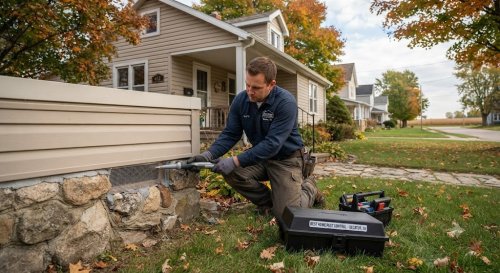
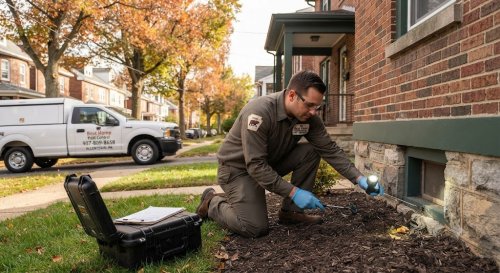
Brick Veneer & Weep Holes: Unprotected weep holes designed for masonry drainage act as open highways for mice, which can squeeze through gaps as small as a dime (1/4 inch or 6–7 mm).
-
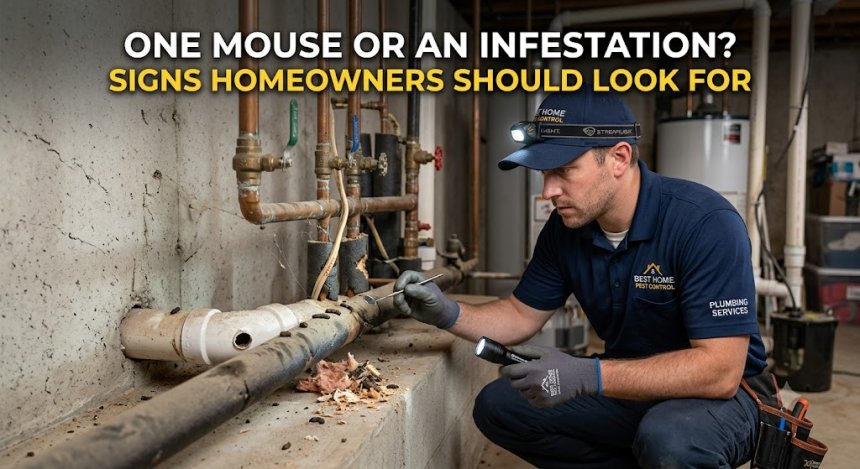
Utility Penetrations & Pipe Chases: Air conditioning lines, gas pipes, and electrical conduit penetrations frequently lack structural sealing, offering uninhibited access straight into utility rooms and kitchens.
-
Overhanging Tree Canopies & Rooflines: Roof rats and deer mice utilize overhanging branches to reach soffit vents, fascia boards, and attic gables, bypassing ground-level barriers entirely.
Seasonal Pest Prevention Framework
Protecting a home from rodent incursions and secondary pest invaders requires a proactive, year-round strategy rooted in Integrated Pest Management (IPM).
Fall/Winter Protocols
-
Exterior Envelope Sealing: Inspect the perimeter foundation, foundation-to-siding junctions, and utility entry points. Fill all gaps larger than $1/4$ inch ($6\text{ mm}$) using rust-proof copper mesh (Stuff-it) packed tightly and topped with exterior-grade polyurethane sealant.
-
Attic & Crawlspace Inspection: Check loose or compressed insulation for rodent tunneling, droppings, or nesting material. Replace damaged vent screens with $1/4\text{-inch}$ galvanized hardware cloth.
-
Firewood Management: Store firewood at least $20\text{ feet}$ away from the home’s foundation and elevated off the ground by $6\text{ inches}$ to eliminate harborage for mice, rats, and wood-destroying insects.
-
Weep Hole Protection: Install stainless steel wire weep hole inserts to preserve airflow while preventing rodent access.
Spring/Summer Protocols
-
Vegetation Clearances: Maintain a strict $18\text{--}24\text{ inch}$ vegetation-free buffer around the foundation perimeter. Prune tree branches back at least $6\text{ feet}$ from the roofline.
-
Drainage & Downspout Grading: Ensure downspouts extend $3\text{--}5\text{ feet}$ away from the foundation. Keep gutters clear to eliminate standing water sources that attract both rodents and pests.
-
Door Sweeps & Screens: Install heavy-duty nylon brush or metal-encased door sweeps on all exterior doors, including garage doors. Ensure window screens fit tightly within frames.
Year-Round Interior Habits
-
Food Storage Protocols: Store dry goods, pet food, and pantry staples in airtight glass or heavy-gauge plastic containers. Avoid leaving pet food out overnight.
-
Relative Humidity Management: Keep basement and crawlspace relative humidity levels below $50\%$ using commercial dehumidifiers to prevent wood rot and deter damp-loving pests.
-
Avoid OTC Repellent Aerosols: Refrain from over-using store-bought repellent aerosol sprays, which drive rodents deeper into inaccessible wall cavities without resolving the nest.
Emergency Dispatch Matrix
When certain signs appear, immediate intervention is necessary to prevent severe structural damage or health hazards.
| Emergency Scenario | Primary Structural & Health Risks | Immediate Action Required |
| Active Rodents in Food Prep or Living Zones | Chewed electrical wiring (fire risk), contamination of food prep areas with Salmonella, Hantavirus, and Leptospirosis. | Isolate food supplies, block immediate room exits if safely possible, and call Best Home Pest Control at 937-809-8658. |
| Stinging Insects inside Wall Voids or Ceilings | Severe drywall collapse from nest moisture; high risk of systemic allergic reactions or anaphylaxis from interior stings. | Do not seal the exterior entry hole (forces insects into the living space). Keep room clear and contact a professional immediately. |
| Interior Wildlife Encounters (Raccoons, Bats, Squirrels) | Rabies transmission risk, severe airborne fungal exposure from guano/feces (Histoplasmosis), destroyed attic insulation. | Isolate the affected area, keep pets and children away, do not attempt manual capture, and call emergency pest dispatch. |
| Severe Bed Bug Infestation (Daylight Sighting on Furniture) | Widespread dispersal throughout structural framing, chronic sleep deprivation, secondary skin infections from bites. | Do not move mattress/furniture to other rooms or hallways. Contact professionals for heat or targeted non-repellent treatment. |
Systematic 5-Step Professional Inspection Workflow
At Best Home Pest Control, our licensed technicians run a complete diagnostic process to identify species, entry points, and nesting density before applying treatments.
+-----------------------------------------------------------------------+
| STEP 1: Exterior Perimeter & Entry Point Mapping                      |
| Inspect foundation, soffits, weep holes, utility penetrations, roof.  |
+-----------------------------------------------------------------------+
                                   |
                                   v
+-----------------------------------------------------------------------+
| STEP 2: Interior Micro-Habitat & Moisture Analysis                    |
| Scan crawlspaces, attics, & plumbing chases using thermal & moisture. |
+-----------------------------------------------------------------------+
                                   |
                                   v
+-----------------------------------------------------------------------+
| STEP 3: Species Identification & Population Density Staging           |
| Assess droppings, gnaw marks, rub lines to gauge infestation size.   |
+-----------------------------------------------------------------------+
                                   |
                                   v
+-----------------------------------------------------------------------+
| STEP 4: Custom Integrated Pest Management (IPM) Formulation          |
| Combine mechanical exclusion, sanitation, and targeted chemistry.     |
+-----------------------------------------------------------------------+
                                   |
                                   v
+-----------------------------------------------------------------------+
| STEP 5: Exclusion Installation, Application & Monitoring              |
| Seal entry points, deploy professional monitoring, schedule follow-up.|
+-----------------------------------------------------------------------+
-
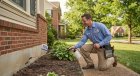
Exterior Perimeter & Entry Point Mapping: We perform a complete $360^\circ$ inspection of the building envelope, checking weep holes, utility chases, garage door seals, and rooflines for active grease marks, gnaw patterns, or structural gaps.
-
Interior Micro-Habitat & Moisture Analysis: Utilizing moisture meters and thermal imaging, we scan dark, humid areas—attics, basements, wall voids, and water lines—to spot hidden moisture leaks and nesting sites.
-
Species Identification & Population Density Staging: We evaluate fecal morphology (droppings shape/size), grease rub tracks, and gnaw severity to differentiate house mice (Mus musculus) from deer mice (Peromyscus) or Norway rats (Rattus norvegicus), establishing whether the problem is an isolated intruder or a breeding colony.
-
Custom IPM Formulation: We build a targeted treatment plan integrating physical exclusion, mechanical trapping, environmental modification, and non-repellent chemistries tailored to your structure.
-
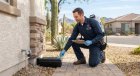
Targeted Application, Exclusion & Follow-Up Monitoring: Technicians seal structural entry routes using heavy-gauge exclusion materials, place tamper-resistant bait stations or mechanical traps along travel pathways, and set schedule checks to confirm full eradication.
DIY Boundaries vs. Professional Interventions
While basic sanitation and light maintenance can be handled by homeowners, significant pest activity requires professional equipment and licensed expertise.
| Safe DIY Homeowner Tasks | High-Risk / Pro-Only Interventions |
| Storing food in glass or plastic airtight containers. | Sealing active rodent entries without removing interior populations first. |
| Clearing debris and leaf litter within $2\text{ feet}$ of foundation. | Handling broad-spectrum chemical sprays inside wall voids or HVAC systems. |
| Replacing worn weatherstripping on entry doors. | Exterminating active nests of stinging insects within wall cavities. |
| Placing snap traps along visible baseboard runs for isolated strays. | Performing structural termite, bed bug, or widespread rodent exclusion. |
4 Critical Trigger Conditions: When to Call a Professional Immediately
-
Daylight Sightings: Mice are nocturnal; seeing a rodent during daylight indicates high population density forcing individuals out of overcrowded nests.
-
Auditory Indicators Behind Walls: Hearing active scratching, scurrying, or squeaking in drywall or ceiling voids, especially at night.
-
Visible Structural Damage: Finding chewed electrical wiring, shredded wall insulation, or frass/mud tubes along foundation lines.
-
Health or Allergic Threats: Any presence of rodent feces near food preparation areas or asthma/allergy flare-ups from pest debris.
Warning Signs: Sensory Diagnostics & Risks of Delay
Rodents leave distinct clues throughout a home long before they are spotted in plain sight.
                      SENSORY DIAGNOSTICS
                               |
       +-----------------------+-----------------------+
       |                       |                       |
       v                       v                       v
   AUDITORY                 VISUAL                 OLFACTORY
• Nighttime scratching  • Rodent droppings      • Stale ammonia smell
• Scurrying in walls    • Grease rub marks      • Musty bed bug scent
• Wood/drywall chewing  • Shredded insulation   • Odor of decay
-
Auditory Diagnostics: Nighttime scurrying, claw scratching inside drywall, or faint squeaking behind kitchen cabinets.
-
Visual Diagnostics: Dark, spindle-shaped droppings ($3\text{--}6\text{ mm}$ long) near food sources, dark grease rub marks along baseboards from oil in rodent fur, chewed food packaging, and shredded paper or fiber insulation.
-
Olfactory Diagnostics: A persistent, stale ammonia-like smell caused by rodent urine accumulation, or a pungent, musty odor pointing to hidden nesting sites.
Cascading Consequences of Delay
Ignoring these warning signs leads to rapid, costly problems:
-
Electrical Fire Hazards: Mice continuously gnaw on hard materials to wear down their fast-growing incisors. Chewed electrical wiring behind walls is a leading cause of unexplained residential fires.
-
Structural Insulation Degradation: Rodents tunnel through fiberglass and cellulose insulation, ruining thermal efficiency and contaminating attics with feces and urine.
-
Airborne Pathogen Exposure: Dried rodent urine and droppings break down into dust particles that circulate through HVAC systems, spreading pathogens like Hantavirus, Leptospirosis, and Lymphocytic Choriomeningitis (LCMV).
Cost Breakdown & Pricing Variables
Professional pest control costs vary depending on the severity of the issue, structural layout, and treatment approach.
-
Initial Diagnostic & Inspection Fees: Thorough structural inspections typically range from $\$75\text{ to }\$200$, often credited toward total treatment costs upon service engagement.
-
Square Footage & Accessibility: Larger homes or structures with difficult crawlspace/attic access require additional labor and materials, scaling the service investment.
-
Treatment Methodology: Standard mechanical trapping and targeted chemical treatments differ in cost from complex heat treatments or structural fumigation required for severe bed bug or drywood termite issues.
-
Custom Exclusion Labor: Physical repair work—such as installing metal flashings, sealing foundation cracks, and capping weep holes—is priced based on the linear feet of protection required.
-
One-Time Emergency vs. Recurring Maintenance Plans: One-time emergency knockdowns generally cost more upfront ($Varying\text{ from }\$250\text{ to }\$600+$), whereas recurring quarterly maintenance plans offer ongoing protection at lower per-visit rates ($Varying\text{ from }\$100\text{ to }\$180\text{ quarterly}$).
Professional Equipment & Diagnostic Arsenal
Modern IPM relies on advanced technology to detect and eliminate pests cleanly and precisely.
| Diagnostic Tool / Technology | Practical Application |
| FLIR Thermal Imaging Cameras | Detects thermal anomalies inside drywall to locate active rodent nests, insect clusters, and hidden moisture leaks without invasive wall cuts. |
| Digital Optical Borescopes | Snake-necked high-definition cameras that enter $1/2\text{-inch}$ holes to inspect floor joists, pipe chases, and hollow wall voids directly. |
| Pinless Moisture Meters | Identifies elevated moisture levels ($>18\%$) in wood joists and subflooring that attract subterranean termites, carpenter ants, and reclusive pests. |
| Acoustic Listening Devices | Amplifies structural vibrations to detect wood-boring larvae, carpenter ant activity, or rodent movement within closed wall systems. |
| Non-Repellent Transfer Chemistries | Advanced non-repellent active ingredients (e.g., Fipronil, Chlorfenapyr) that pests unknowingly carry back to the central colony for complete eradication. |
Industry Hard Truths & Insider Facts
-
Over-the-Counter Foggers Make Infestations Worse: Total-release "bug bombs" use repellent pyrethroids that do not penetrate deep wall voids. They spray surface areas, causing pests to scatter deeper into structural crevices or split into sub-colonies (budding).
-
Ultrasonic Plug-in Repellers Are Scientifically Ineffective: Controlled FTC and university studies show that rodents rapidly habituate to high-frequency sound waves. These devices offer zero long-term deterrence.
-
Chemical Sprays Without Physical Exclusion Always Fail: Spraying liquid insecticides or setting traps without sealing structural entry points is a temporary band-aid. Unsealed homes will continuously attract new rodent populations from outdoors.
-
The Homeowner Insurance Trap: Standard homeowners insurance policies almost universally exclude damage caused by termites, insects, and rodents, classifying pest activity as preventable home maintenance.
Frequently Asked Questions
How fast can I expect complete colony elimination after treatment begins?
For typical house mouse infestations, targeted mechanical trapping combined with entry exclusion yields complete control within $7\text{ to }14\text{ days}$. Complex subterranean termite or bed bug treatments using non-repellent transfer chemistry or thermal methods may require $30\text{ to }60\text{ days}$ to achieve total colony elimination.
Are professional pest control applications safe for my pets and children?
Yes. Modern IPM practices prioritize targeted, low-volatility formulations applied inside tamper-resistant bait stations or direct wall-void injections. Technicians ensure products are secured away from non-target areas, requiring only short drying windows (typically $2\text{ to }4\text{ hours}$) before re-entry.
How can I visually tell the difference between winged termites and swarming carpenter ants?
-
Waist: Termites have a uniform, straight waist, while carpenter ants have a distinct pinched waist.
-
Antennae: Termite antennae are straight and bead-like; ant antennae are elbowed/bent.
-
Wings: Termite swarming wings are equal in length and shape; carpenter ants feature larger front wings and smaller hind wings.
How should I prepare my home for a professional pest control service?
Clear access to perimeter walls, under-sink cabinets, utility rooms, and attics. Ensure all food is stored in sealed containers, vacuum floors thoroughly, remove pet bowls/toys, and keep pets secured during the technician's visit.
Why do I see an increase in pest activity right after a professional treatment?
This is known as the "flushing effect." Non-repellent chemistries and bait formulations irritate or disrupt the pest’s nervous system, forcing hidden individuals out of wall voids in search of water or relief before they die. Activity typically drops off sharply within a few days.
Why does standard expanding spray foam fail to stop rodents?
Standard polyurethane expanding foam dries soft and porous. Mice and rats can chew through standard spray foam in minutes. Effective exclusion requires copper mesh or steel wool embedded into high-density sealant or backing with stainless steel plates.
How often should a home undergo professional pest inspections?
In most regions of the USA, a comprehensive professional inspection should be performed annually. Homes in damp climates or mature, wooded neighborhoods benefit from bi-annual or quarterly preventative visits to catch entry points before infestations take hold.
What are the primary foundation attractants for subterranean termites?
Direct wood-to-ground contact (such as door frames or deck posts), excess moisture from leaking hose bibbs or clogged gutters, stacked firewood near the foundation, and heavy mulch layers holding moisture against external walls.
Take Action: Stop Rodents Before They Multiply
If you have spotted a mouse, heard scratching behind your walls, or found chewed packaging, do not wait for a full-scale infestation to take hold. Contact the licensed specialists at Best Home Pest Control today for a comprehensive home inspection and exclusion plan.
-
Direct Line: 937-809-8658
-
Service: Complete IPM Diagnostics, Rodent Exclusion & Pest Prevention