Can Mice Get Into Your House Through the Garage Door
pest control USA, exterminator USA, rodent control, mice garage door entry, termite inspection, emergency pest control, pest prevention tips, garage door weatherstripping

Can Mice Get Into Your House Through the Garage Door
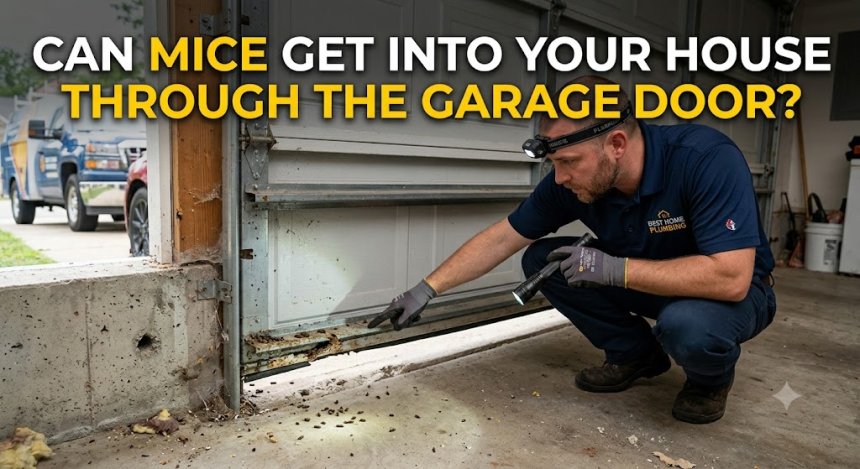
the garage door is one of the single most common entry points for mice entering residential structures. A house mouse (Mus musculus) needs a opening of only $1/4$ inch ($6\text{ mm}$)—roughly the diameter of a standard pencil—to squeeze through. Because garage doors are subject to daily mechanical stress, thermal expansion, and floor settling, their bottom rubber seals (astragals) and side weatherstripping rapidly wear down, creating ideal runways for opportunistic rodents.
Localized Introduction & Architectural Triggers
Residential properties across the USA feature attached garages that act as transitional zones between outdoors and interior living quarters. Environmental pressures—such as severe autumn temperature drops in northern regions, heavy regional precipitation, or summer heatwaves—drive rodents to seek shelter, food, and nesting materials within climate-buffered garage spaces.
Several architectural vulnerabilities surrounding garage doors grant rodents access:
-
Worn or Chewed Bottom Astragals: Rubber bottom seals degrade over time due to friction, sun exposure, and sub-zero freeze cycles. Mice chew through vinyl and rubber seals to enlarge gaps at garage door corners.
-
Corner Gaps & Foundation Settling: Where the garage door frame meets the concrete slab foundation, natural settling creates ground-level gaps. Standard rubber astragals rarely seal completely against uneven or pitted concrete floors.
-
Unsealed Interior Access Doors: Garage interiors frequently feature unsealed utility chases, laundry room doorways, and hot water heater penetrations leading directly into drywall voids and kitchen kitchens.
-
Stored Items & Harborage: Cardboard storage boxes, lawn equipment, and stacked firewood inside garages offer ideal nesting material and concealed travel routes adjacent to the house entryway.
Seasonal Pest Prevention Framework
Blocking garage door entry and preventing secondary pest infestation requires a multi-layered Integrated Pest Management (IPM) approach.
Fall/Winter Protocols
-
Garage Door Threshold & Astragal Upgrade: Replace worn vinyl bottom seals with heavy-duty, rodent-proof rubber astragals reinforced with internal stainless steel wire mesh or nylon brush barriers.
-
Exterior Envelope Sealing: Inspect garage frame perimeters. Fill gaps larger than $1/4$ inch ($6\text{ mm}$) using rust-proof copper mesh (Stuff-it) packed tightly and sealed with exterior polyurethane sealant.
-
Firewood & Box Storage: Store firewood at least $20\text{ feet}$ away from the home and elevated $6\text{ inches}$ off the ground. Swap cardboard boxes inside the garage for sealed, heavy-gauge plastic totes.
-
Interior Garage Thresholds: Install metal-encased or heavy-duty brush door sweeps on the interior door connecting the garage to the living space.
Spring/Summer Protocols
-
Perimeter Vegetation Clearances: Maintain an $18\text{--}24\text{ inch}$ gravel or stone vegetation-free border around the garage foundation. Prune shrubs and tree limbs back at least $6\text{ feet}$ from the garage roofline.
-
Downspout & Drainage Maintenance: Direct downspouts $3\text{--}5\text{ feet}$ away from garage footings to prevent concrete erosion, pitting, and pooling water that attracts pests.
-
Garage Lighting Adjustments: Replace standard exterior incandescent floodlights over garage doors with yellow LED or sodium-vapor lighting to minimize insect attraction, which in turn reduces rodent feeding triggers.
Year-Round Interior Habits
-
Food & Pet Kibble Storage: Never leave open bags of grass seed, birdseed, or pet food in the garage. Store all organic material in airtight metal or heavy-duty plastic bins with locking lids.
-
Garage Relative Humidity Targets: Keep garage workshop areas and adjacent crawlspaces dry; maintain relative humidity below $50\%$ to deter wood-boring insects and damp-loving rodents.
-
Avoid Repellent Aerosol Misuse: Avoid spraying aerosol repellents around garage door tracks. This scatters rodents into interior wall voids rather than driving them outside.
Emergency Dispatch Matrix
When garage door pest activity escalates into living areas, immediate professional intervention is required.
| Emergency Scenario | Primary Structural & Health Risks | Immediate Action Required |
| Active Rodents Spreading from Garage to Kitchen/Living Zones | Chewed wiring (fire hazard), contamination of food prep surfaces with Salmonella and Hantavirus. | Secure open food, isolate living zones, and call Best Home Pest Control at 937-809-8658. |
| Stinging Insects Nesting inside Garage Wall Voids or Ceilings | Drywall structural damage from nest moisture; high risk of stings or severe allergic reactions when operating garage doors. | Keep garage door closed if possible; do not block external entry points. Call professionals immediately. |
| Wildlife Encounters inside Garage (Raccoons, Squirrels, Bats) | Risk of rabies transmission, destruction of ceiling insulation, fire risk from chewed auto/garage opener wiring. | Vacate garage, keep interior access doors locked, avoid cornering animals, and contact emergency pest dispatch. |
| Severe Bed Bug or Cockroach Dispersal via Stored Garage Items | Rapid spreading into structural framing, car interiors, and bedrooms via stored furniture or clothing. | Do not move items from garage into the main home. Schedule professional targeted heat or non-repellent treatment. |
Systematic 5-Step Professional Inspection Workflow
At Best Home Pest Control, our licensed specialists deploy a rigorous, step-by-step diagnostic workflow to permanently resolve garage door rodent entry.
+-----------------------------------------------------------------------+
| STEP 1: Garage Door & Exterior Perimeter Entry Point Mapping          |
| Inspect astragals, track alignment, corner gaps, & foundation joints. |
+-----------------------------------------------------------------------+
                                   |
                                   v
+-----------------------------------------------------------------------+
| STEP 2: Interior Garage & Wall Void Micro-Habitat Analysis            |
| Scan drywall penetrations, utility conduits, & attic access hatches.   |
+-----------------------------------------------------------------------+
                                   |
                                   v
+-----------------------------------------------------------------------+
| STEP 3: Species Identification & Population Density Staging           |
| Evaluate droppings, gnaw marks, & rub lines along garage baseboards.  |
+-----------------------------------------------------------------------+
                                   |
                                   v
+-----------------------------------------------------------------------+
| STEP 4: Custom Integrated Pest Management (IPM) Formulation          |
| Combine industrial exclusion, sanitation, & non-repellent controls.  |
+-----------------------------------------------------------------------+
                                   |
                                   v
+-----------------------------------------------------------------------+
| STEP 5: Exclusion Installation, Trapping & Follow-Up Monitoring       |
| Seal gaps, set tamper-resistant traps, & verify total elimination.    |
+-----------------------------------------------------------------------+
-
Garage Door & Exterior Perimeter Entry Point Mapping: We execute a detailed inspection of garage door bottom seals, vertical track weatherstripping, concrete threshold alignment, and exterior wall-floor junctions to pinpoint every gap exceeding $1/4\text{ inch}$.
-
Interior Garage & Wall Void Micro-Habitat Analysis: Technicians use moisture meters and optical borescopes to inspect utility line penetrations, water heater closets, drywall joints, and garage attic access points.
-
Species Identification & Population Density Staging: We evaluate dropping size, gnaw depth on door gaskets, and grease rub tracks along garage wall studs to confirm whether the invader is a house mouse (Mus musculus), deer mouse (Peromyscus), or Norway rat (Rattus norvegicus).
-
Custom IPM Formulation: We formulate a site-specific protocol combining industrial-grade mechanical exclusion, physical habitat modification, mechanical trapping, and targeted non-repellent controls.
-
Exclusion Installation, Trapping & Follow-Up Monitoring: We replace compromised garage door seals with rodent-proof astragals, seal structural voids with copper mesh and polyurethane sealants, deploy secure trapping arrays, and return to confirm complete elimination.
DIY Boundaries vs. Professional Interventions
While basic cleaning and box storage can be done by homeowners, complete structural rodent-proofing requires professional equipment and materials.
| Safe DIY Homeowner Tasks | High-Risk / Pro-Only Interventions |
| Storing pet food and birdseed in metal or heavy plastic containers. | Installing industrial rodent-proof garage astragals on commercial/residential roll-up tracks. |
| Clearing stored cardboard and debris $2\text{ feet}$ away from garage walls. | Applying non-repellent chemical transfer agents within garage wall voids. |
| Sweeping garage floors to remove seeds, spills, and nesting debris. | Eradicating large hornets' or yellowjackets' nests built inside garage wall cavities. |
| Setting snap traps along interior garage walls for single stray mice. | Completing full structural exclusion along foundation expansion joints and roof soffits. |
4 Critical Trigger Conditions: When to Call a Professional Immediately
-
Daylight Sightings: Spotting a rodent in the garage or living room during daylight indicates an overgrown population forcing animals out of primary harborage.
-
Auditory Signs in Wall Voids: Scratching, chewing, or scurrying noises inside the wall separating the garage from the home.
-
Chewed Wiring or Gaskets: Deep gnaw marks on garage door bottom seals, car engine wiring harnesses, or electrical outlet boxes.
-
Feces Near Home Access Doors: Accumulations of rodent droppings along the interior threshold between the garage and house.
Warning Signs: Sensory Diagnostics & Risks of Delay
Rodents leave distinct clues inside garages long before they are seen directly.
                      SENSORY DIAGNOSTICS
                               |
       +-----------------------+-----------------------+
       |                       |                       |
       v                       v                       v
   AUDITORY                 VISUAL                 OLFACTORY
• Scratching behind drywall • Chewed rubber seals   • Stale urine odors
• Scurrying in rafters      • Droppings near boxes  • Musty nest smell
• Gnawing on wooden frames  • Dark grease rub marks • Odor of decomposition
-
Auditory Diagnostics: Persistent scratching or scurrying overhead in garage ceiling rafters or within the wall shared with the kitchen or home interior.
-
Visual Diagnostics: Dark, spindle-shaped droppings ($3\text{--}6\text{ mm}$) scattered near stored goods or garage door corners; dark grease marks along baseboards; torn insulation; chewed rubber astragals.
-
Olfactory Diagnostics: Pungent, stale urine smells concentrated around garage storage corners, or a sharp, musty odor pointing to concealed active nests.
Cascading Consequences of Delay
Ignoring garage door rodent entry leads to severe structural and financial issues:
-
Electrical Fire Hazards: Mice chew constantly on wiring harnesses, garage opener power cables, and interior wall wiring, presenting a significant hidden fire hazard.
-
Vehicle Damage: Mice frequently enter parked cars inside garages, building nests in cabin air filters and destroying expensive engine wiring harnesses.
-
Pathogen Spread to Living Quarters: Once established in the garage, mice use shared utility lines to bring Salmonella, Hantavirus, and LCMV directly into kitchen pantries and food storage areas.
Cost Breakdown & Pricing Variables
Professional garage rodent exclusion and eradication pricing depends on structure size, extent of entry damage, and required materials.
-
Initial Diagnostic & Inspection Fees: Thorough structural inspections typically range from $\$75\text{ to }\$200$, which is routinely credited toward overall service costs upon treatment plan agreement.
-
Garage Size & Door Configuration: Single-car garages require less material and labor than double or multi-bay garages with multiple roll-up doors and complex weatherstripping needs.
-
Exclusion Material Requirements: Installing specialized rodent-resistant rubber astragals, stainless steel mesh thresholds, metal flashing, and sealing utility penetrations scales with linear footage ($Varying\text{ from }\$200\text{ to }\$600+$).
-
Treatment & Trapping Scope: Intensive trapping programs, non-repellent wall void treatments, and sanitation services vary based on infestation density ($Varying\text{ from }\$250\text{ to }\$500$).
-
Recurring Maintenance Plans: Ongoing quarterly service plans ensure garage perimeters remain sealed and monitor for new activity ($Varying\text{ from }\$100\text{ to }\$180\text{ quarterly}$).
Professional Equipment & Diagnostic Arsenal
Modern IPM utilizes specialized technology to diagnose and eliminate pest entries without destructive wall cutting.
| Diagnostic Tool / Technology | Practical Application |
| FLIR Thermal Imaging Cameras | Pinpoints heat patterns of hidden rodent clusters and pinpoints cold air drafts caused by missing garage door seals. |
| Digital Optical Borescopes | Flexible HD cameras inserted through minor openings to inspect garage wall voids, ceiling joists, and motor housings. |
| Pinless Moisture Meters | Detects hidden water leaks and high wood moisture levels ($>18\%$) in garage framing that attract termites and Carpenter ants. |
| Acoustic Listening Devices | High-sensitivity acoustic sensors that amplify chewing and clawing sounds within sealed garage walls. |
| Non-Repellent Transfer Chemistries | Advanced active ingredients (e.g., Fipronil, Chlorfenapyr) that pests spread through colonies without triggering scatter effects. |
Industry Hard Truths & Insider Facts
-
Expanding Spray Foam Does Not Stop Rodents: Standard spray foam cures into soft, porous foam that mice chew through in minutes. Effective exclusion requires copper mesh or steel wool embedded into high-density polyurethane sealant.
-
Over-the-Counter Foggers Cause Infestations to Spread: "Bug bombs" utilize repellent pyrethroids that fail to penetrate deep wall voids. They drive garage pests deeper into interior home walls.
-
Ultrasonic Plug-in Devices Are Ineffective: FTC tests and independent university research confirm rodents quickly adapt to ultrasonic frequency sound emitters, rendering them useless for long-term control.
-
Insurance Does Not Cover Rodent Damage: Most standard homeowners insurance policies classify rodent, insect, and termite damage as "preventable home maintenance," leaving homeowners fully responsible for repair costs.
Frequently Asked Questions
How fast can I expect complete colony elimination after garage exclusion begins?
With professional trapping arrays combined with mechanical garage door exclusion, typical house mouse infestations inside garages are brought under complete control within $7\text{ to }14\text{ days}$.
Are professional pest control applications safe for my pets and family?
Yes. Modern IPM practices utilize targeted, low-volatility products applied inside tamper-proof bait stations or injected directly into inaccessible wall voids, keeping pets and children completely safe.
How do I visually tell the difference between winged termites and swarming carpenter ants in my garage?
-
Waist: Termites have a uniform, straight waist; carpenter ants have a distinct, pinched waist.
-
Antennae: Termite antennae are straight and bead-like; carpenter ant antennae are elbowed and bent.
-
Wings: Termites feature four wings of equal length; carpenter ants have longer front wings and shorter hind wings.
What steps should I take to prepare my garage for professional treatment?
Clear a $2\text{-foot}$ path along all interior garage walls, elevate stored items off the floor where possible, remove open food or seed bags, and ensure technicians have direct access to garage door tracks and utility penetrations.
Why do I see an increase in pest activity right after a professional treatment?
This is known as the "flushing effect." Non-Repellent treatments and bait products disrupt the pest’s nervous system or habits, forcing hidden rodents or insects out into open areas before they die off.
Why does standard rubber garage door weatherstripping fail against mice?
Standard vinyl and soft rubber astragals offer no physical resistance against rodent incisors. Mice chew through soft rubber corner gaskets effortlessly. Effective seals require wire-mesh-reinforced rubber or heavy-gauge nylon brush seals.
How often should a home undergo professional pest inspections?
In most USA regions, a thorough professional pest and structural exclusion inspection should be conducted annually. Properties adjacent to wooded areas or with attached garages benefit from semi-annual or quarterly visits.
What are the primary garage foundation attractants for subterranean termites?
Direct wood-to-concrete contact (such as garage wall studs touching untreated concrete slabs), excess moisture from leaking hose bibbs or water heaters, and stored cardboard or lumber touching raw foundation walls.
Secure Your Garage Door Today
Do not let a worn garage door seal turn into a major home rodent infestation. Contact the licensed specialists at Best Home Pest Control today for an expert inspection and industrial exclusion setup.
-
Direct Line: 937-809-8658
-
Service: Complete Garage Exclusion, IPM Diagnostics & Rodent Control