USA Pest Control: Early Termite Inspection & Removal | Best Home Pest Control
Detect subterranean termites before structural damage occurs. Expert USA termite inspection, early warning signs, and IPM prevention plans. Call 937-809-8658.

Localized Introduction & Architectural Triggers
Subterranean termites (Reticulitermes species) cause billions in structural damage across the United States annually, operating silently behind drywall, subflooring, and foundation walls. Because subterranean termites nest underground and construct microscopic mud conduits to reach wooden structural members, an infestation often remains completely invisible to the untrained eye until load-bearing elements suffer severe integrity loss.
TYPICAL SUBTERRANEAN TERMITE ENTRY PATHS
[ Home Interior: Wood Framing / Subfloor ]
▲
│ (Hidden Mud Tubes)
[ Expansion Joints / Foundation Cracks / Utility Chases ]
▲
│ (Capillary Moisture & Shelter)
[ Soil Barrier / Grade Line (Mulch, Soil-to-Wood Contact) ]
▲
│ (Primary Colony)
[ Underground Subterranean Nest ]
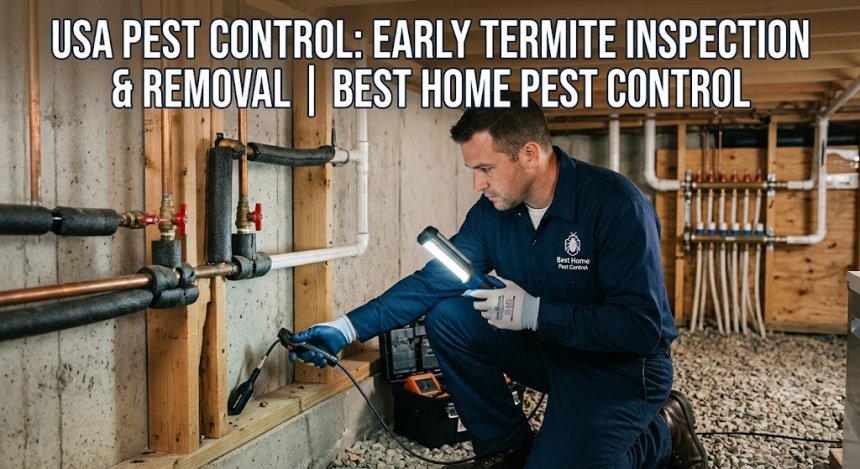
Across American housing inventory—ranging from mid-century crawlspaces and slab-on-grade suburban developments to historical fieldstone and full-basement constructions—several distinct architectural and climate factors drive early, hidden infestations:
-
Slab-on-Grade Expansion Joints & Plumbing Chases: Micro-cracks as narrow as $0.5\text{ mm}$ ($1/32\text{ inch}$) in concrete slabs allow subterranean termites direct entry from damp soil into interior partition walls without exposing exterior shelter tubes.
-
Crawlspace Relative Humidity & Wood-to-Soil Contact: Poorly ventilated crawlspaces with dirt floors create persistent microclimates exceeding $70\%$ relative humidity. Siding or deck posts that contact soil directly provide unhindered, subterranean highways directly into floor joists.
-
Seasonal Weather Triggers: Spring thaws, heavy precipitation, and warm seasonal temperature shifts elevate soil moisture levels. This hydraulic pressure drives worker termites upward into subflooring while triggering mass swarming flights of reproductive alates looking for hidden entry points.
3. Seasonal Pest & Termite Prevention Framework
Preventing hidden termite colony establishment requires maintaining structural envelope integrity and controlling environmental moisture year-round.
Fall/Winter Protocols
-
Maintain Exterior Envelope: Inspect foundation walls, basement bulkheads, and exterior stucco/siding for foundation settling cracks. Seal masonry voids exceeding $1/16\text{ inch}$ using polyurethane masonry sealant.
-
Firewood & Lumber Storage: Elevate stored firewood and construction lumber at least $6\text{ inches}$ above the ground on concrete piers, maintaining a minimum $20\text{ foot}$ separation from any residential structure exterior wall.
-
Weep Hole Integrity: Equip masonry weep holes with stainless steel mesh covers ($1\text{ mm}$ grid width) to maintain proper brick cavity ventilation while excluding pest entry.
-
Crawlspace Vents: Close or insulate exterior crawlspace vents during freezing months if unencapsulated, ensuring crawlspace pipes do not sweat and drop moisture onto sills.
Spring/Summer Protocols
-
Vegetation Clearances: Maintain an $18\text{ to }24\text{ inch}$ clearance zone of gravel or crushed rubber mulch between foundation perimeter walls and landscape plantings or wood mulch beds.
-
Drainage & Downspouts: Extend downspout splash blocks or flexible piping at least $5\text{ feet}$ away from foundation perimeter walls. Ensure soil grade slopes away from the foundation at a rate of $6\text{ inches}$ drop per $10\text{ feet}$.
-
Moisture Abatement: Repair dripping hose bibbs, air conditioner condensation lines, and leaking window gutters immediately to eliminate localized subterranean moisture reservoirs.
-
Door Sweeps & Screens: Install heavy-duty nylon brush door sweeps on garage doors and replace torn mesh window screens to exclude swarming alates during spring flights.
Year-Round Interior Habits
-
Relative Humidity Targets: Deploy commercial-grade dehumidifiers in basements and crawlspaces to maintain indoor relative humidity consistently under $50\%$.
-
Plumbing Void Audits: Regularly inspect pipe penetrations beneath kitchen sinks, bathroom vanities, and water heater closets for pinhole leaks or condensation buildup.
-
Avoid Repellent Aerosol Misuse: Refrain from spraying over-the-counter pyrethroid sprays on suspected termite swarmers or mud tubes; synthetic pyrethroids scatter worker termites deeper into inaccessible wall cavities.
4. Emergency Dispatch Matrix
| Emergency Scenario | Primary Structural & Health Risks | Immediate Action Required |
| Indoor Termite Swarmers (Winged Alates) | Indicates a mature, well-established colony operating inside or directly beneath the home structure. | Call 937-809-8658. Vacuum up dropped wings/swarming adults for species identification. Do not apply aerosol sprays. |
| Active Rodents in Living/Prep Zones | Gnawed electrical wiring (fire hazard), food contamination, leptospirosis, and hantavirus transmission. | Isolate food supplies in sealed glass/metal containers. Block interior utility openings with copper mesh. Schedule urgent trapping. |
| Stinging Insect Nest in Wall Cavity | Anaphylaxis hazard, ceiling/drywall saturation from honey/larval rot, wall breakdown. | Keep room sealed. Do not plug exterior exit hole (forces stinging insects into interior living space). |
| Interior Wildlife Encounters (Raccoons/Bats) | Direct bite/rabies hazards, airborne histoplasmosis from guano/feces accumulators. | Vacate immediate room, seal doors, and contact emergency wildlife extraction immediately. |
5. Systematic 5-Step Professional Inspection Workflow
[ Step 1: Perimeter Mapping ] ──► [ Step 2: Diagnostic Inspection ] ──► [ Step 3: Staging ]
                                                                             │
[ Step 5: Targeted Application & Exclusion ] ◄── [ Step 4: IPM Formulation ] ◄┘
-
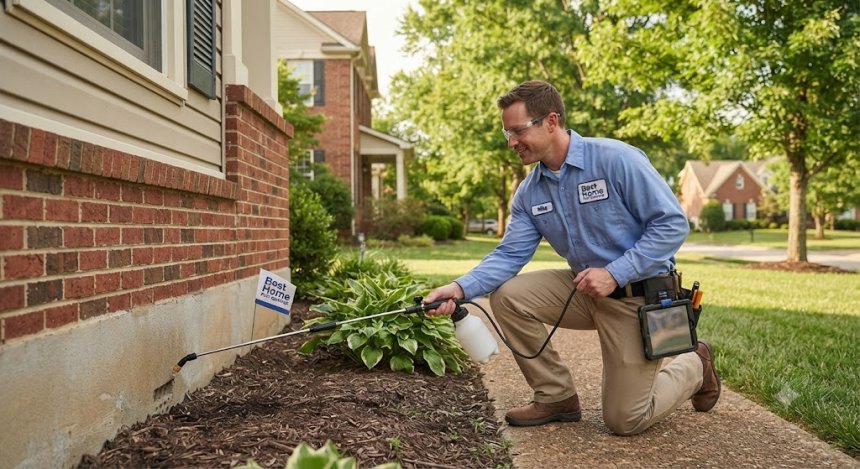
Exterior Perimeter & Entry Point Mapping: Inspect foundation perimeter, slab seams, deck ledgers, window wells, and utility penetrations. Map soil grade heights, wood-to-ground contacts, and moisture gradients using physical diagnostic site maps.
-
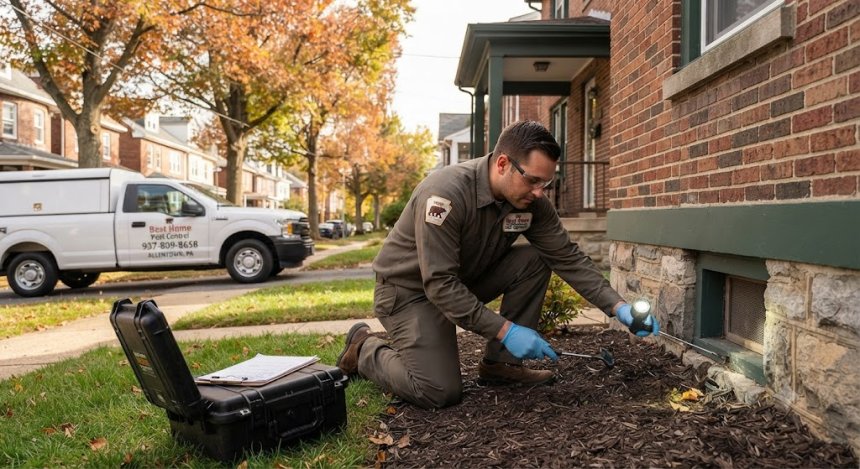
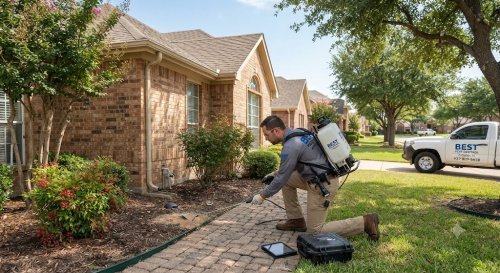
Interior Micro-Habitat & Moisture Analysis: Systematically scan baseboards, headers, sill plates, and subfloors using pinless moisture meters and FLIR thermal imaging cameras. Identify anomalous thermal cold spots caused by moisture retention in termite-damaged framing members.
-
Species Identification & Population Density Staging: Identify specific termite species (Reticulitermes flavipes, Formosan subterranean, or Drywood termites) based on discarded wing vein structures, soldier head capsules, or frass morphology. Classify infestation density: Early Stage (localized exploratory tubes), Intermediate Stage (multiple structural entries), or Advanced Stage (wall void structural hollows).
-
Custom Integrated Pest Management (IPM) Formulation: Develop a site-specific IPM protocol incorporating physical exclusion, environmental moisture remediation, non-repellent liquid soil barriers, and subterranean baiting networks tailored to the specific architecture.
-
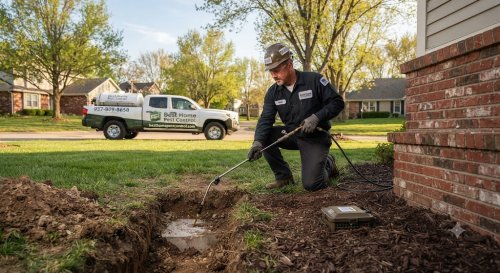
Targeted Application, Exclusion Installation & Follow-Up Monitoring: Apply precision non-repellent transfer chemistry (e.g., fipronil or chlorfenapyr) into foundation trenching or sub-slab injection holes. Install subterranean monitoring/bait stations around the exterior perimeter. Conduct mandatory 30-day, 90-day, and annual follow-up inspections.
6. DIY Boundaries vs. Professional Interventions
| Safe DIY Homeowner Tasks | High-Risk / Pro-Only Interventions |
| Clearing leaf litter, organic mulch, and wood debris $24\text{ inches}$ from foundation perimeter walls. | Sub-slab drilling and high-pressure liquid chemical barrier injection into foundation footings. |
| Extending downspouts $5\text{ feet}$ away from exterior walls and repairing leaking hose bibbs. | Direct interior wall void foaming using non-repellent termiticide chemistries. |
| Installing stainless steel weep hole covers and nylon brush door sweeps. | Structural load-bearing header and floor joist restoration or structural fumigation. |
| Vacuuming up dead swarming insects and saving specimen samples in alcohol for pro identification. | Installation and monitoring of professional subterranean bait station networks. |
🚨 Critical Call Triggers (Call 937-809-8658 Immediately):
Discarded translucent insect wings found in quantity on interior window sills.
Hardened mud tubes branching up concrete foundation walls or crawlspace piers.
Drywall bubbling, blistered paint, or hollow sounding wood framing when tapped.
Auditory clicking or rustling noises emanating from interior wall cavities.
7. Warning Signs: Early Sensory Diagnostics & Risks of Delay
Early Sensory Indicators
-
Visual Indicators:
-
Discarded Swarmer Wings: Piles of equal-length, translucent wings near windows, entry doors, or light fixtures.
-
Mud Shelter Tubes: Pencil-thin earthen conduits traveling up foundation walls, floor joists, or plumbing pipes.
-
Blistered Wood/Paint Finish: Drywall or trim paint showing fine ripples, bubbling, or cracking similar to localized water damage.
-
Sub-Surface Frass/Earthen Packing: Tiny soil particles lining baseboards, window casings, or electrical outlets.
-
-
Auditory Indicators:
-
Head-Banging Vibrations: Soft, rhythmic clicking or rustling sounds inside walls caused by soldier termites striking wood fibers when alarmed.
-
Hollow Wood Resonances: Dense structural timbers yielding a dry, papery, hollow sound when tapped with a rubber mallet.
-
-
Olfactory Indicators:
-
A persistent, dank, musty soil odor originating from localized baseboard sections or crawlspace access points where worker activity retains elevated moisture levels.
-
Structural & Financial Risks of Delay
Postponing professional termite inspection and intervention leads to severe structural degradation. Subterranean workers feed $24/7$ on cellulose materials within load-bearing studs, floor joists, rim joists, and roof trusses. Advanced subterranean infestations compromise structural integrity, leading to sagging floor grids, binding door frames, wall collapse, and tens of thousands of dollars in uninsured restoration costs.
8. Cost Breakdown & Pricing Variables
Professional termite management pricing depends on several key structural and geographic parameters:
-
Initial Diagnostic Inspection Fee:
-
Comprehensive Structural & Thermal Inspection: Ranges from $\$100\text{ to }\$250$ (frequently credited toward full-service treatment contracts).
-
-
Treatment Methodology:
-
Non-Repellent Liquid Barrier Treatment (Trenching & Rodding): $\$800\text{ to }\$2,500+$, calculated primarily at $\$10\text{ to }\$20$ per linear foot around the exterior foundation perimeter.
-
Subterranean Baiting System Installation & Annual Service: $\$800\text{ to }\$1,800$ initial setup, plus $\$300\text{ to }\$500$ annual monitoring and maintenance fees.
-
Localized Spot & Wall Void Foam Treatments: $\$350\text{ to }\$800$ for limited, early-stage interventions.
-
-
Key Pricing Drivers:
-
Total exterior foundation perimeter footage and structural footprint.
-
Foundation type (crawlspace, concrete slab, full basement, or mixed construction).
-
Need for specialized sub-slab concrete drilling through patios, garages, or tiled slab floors.
-
Severity of moisture intrusion and required physical exclusion/structural repairs.
-
9. Professional Equipment & Diagnostic Arsenal
| Diagnostic / Treatment Equipment | Practical Application & Operational Standard |
| FLIR Thermal Imaging Cameras | Detects subtle temperature differentials on drywall surfaces, pinpointing hidden moisture pockets and dense termite gallery activity without destructive wall opening. |
| Pinless & Pin-Type Moisture Meters | Quantifies moisture content percentage inside structural timbers and baseboards. Moisture levels above $18–20\%$ indicate structural vulnerability to subterranean termites. |
| High-Resolution Digital Borescopes | Inserted through tiny $1/4\text{ inch}$ access holes to visually inspect hidden wall cavities, pipe chases, and enclosed floor joists. |
| Acoustic Listening Devices | Amplifies structural sound waves to detect microscopic movement and soldier termite head-banging inside wall voids. |
| Non-Repellent Transfer Chemistries (Fipronil / Chlorfenapyr) | Undetectable liquid termiticides applied to soil. Worker termites pass through chemistry without repelling, transferring the active agent to the entire colony via grooming (trophallaxis). |
10. Industry Hard Truths & Insider Facts
-
OTC Foggers & Bombs Fail Completely: Over-the-counter total-release insect foggers rely on synthetic pyrethroids that act as repellents. They cannot penetrate dense wood where termites feed, and they cause worker termites to split into secondary sub-colonies (budding), exacerbating structural damage.
-
Ultrasonic Repellers Are Ineffective: Peer-reviewed entomological studies confirm that ultrasonic and electromagnetic plug-in pest control devices have zero impact on termite behavior or nest eradication.
-
Chemical Application Without Moisture/Exclusion Control Fails: Termiticide applications are only half the solution. If structural leaks, poor grading, or soil-to-wood contacts remain uncorrected, termites will eventually find unprotected paths into the home.
-
The Insurance Exclusion Trap: Standard homeowners insurance policies almost universally exclude termite damage. Insurance providers classify termite infestation as preventable home maintenance rather than sudden or accidental physical damage.
11. Comprehensive FAQ Section
How long does it take to eliminate a subterranean termite colony fully?
Using modern non-repellent transfer chemistries or insect growth regulator (IGR) baiting stations, total colony elimination typically occurs within $60\text{ to }90\text{ days}$. This timeline ensures the active chemistry transfers thoroughly to the queen and reproductive members.
Are professional termite treatments safe for my children and pets?
Yes. Once professional applications of EPA-registered non-repellent chemistries (such as fipronil) dry completely (typically $2\text{ to }4\text{ hours}$), they bind tightly to soil particles and construction materials, posing negligible risk to family members or pets.
How do I visually tell the difference between winged termites and swarming carpenter ants?
-
Waist: Termites have a straight, uniform waist; carpenter ants feature a pinched, narrow waist.
-
Antennae: Termites have straight, bead-like antennae; carpenter ants have bent, elbowed antennae.
-
Wings: Termite wings consist of four equal-sized translucent wings; carpenter ants have larger front wings and significantly smaller hind wings.
How should a homeowner prepare for a professional termite inspection?
Clear access pathways ($2\text{ to }3\text{ feet}$) along interior basement/crawlspace walls, utility closets, and beneath kitchen/bathroom sinks. Ensure exterior foundation walls are cleared of stored items, stacked boxes, or heavy dense foliage.
Why do I see an increase in insect activity immediately after treatment?
This is the expected "flushing effect." Non-repellent chemistries disrupt termite central nervous systems and social structures, causing affected workers to lose directional sense and emerge onto exposed surfaces before dying.
Why does standard expanding spray foam fail against pests and termites?
Standard polyurethane expanding foam cures into a soft, cellular matrix that rodents easily chew through and subterranean termites readily bore through to build sheltered conduits. Effective pest exclusion requires dense sealant backed with copper mesh or stainless steel wool.
How often should a home undergo a professional termite inspection?
Industry standards mandate a professional, comprehensive termite and wood-destroying organism (WDO) inspection once every $12\text{ months}$ to ensure protective barriers remain intact and identify early architectural risks.
What are the primary foundation attractants for subterranean termites?
The primary attractants are elevated soil moisture, poor foundation grading, rotting wood landscape ties, untreated soil-to-wood structural contacts, unsealed concrete expansion joints, and persistent plumbing leaks near exterior walls.
Need an Immediate Inspection?
Protect your property investment before visible structural damage occurs. Contact Best Home Pest Control today at 937-809-8658 to schedule a professional termite inspection and IPM protection strategy.